Takagi-Yōshin-Ryū
A willow bends, a tall tree breaks. With this lesson from his father, Takagi Oriemon Shigenobu built a school whose philosophy is yielding.
- Chapter
- 7, The Legacy of the Ninja
- Sections
- 2
- Reading time
- 2 min
The School of the Tall Tree and the Willow Spirit
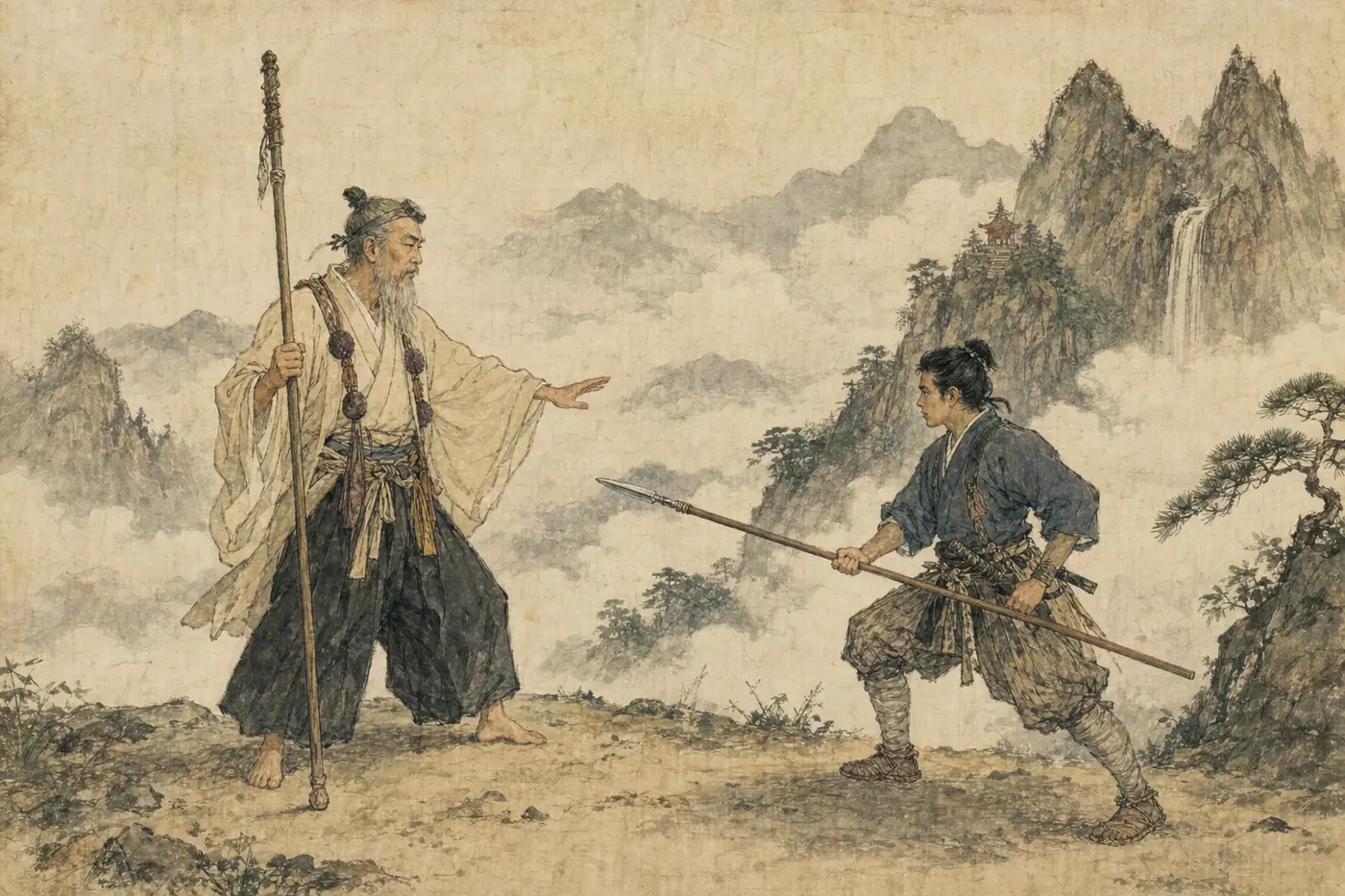
Unryū, the Mountain Priest
In 1569, during the Eiroku era (1558–1570), a mountain priest from the Abe family lived in the Funagata Yama area of Miyagi. People called him Unryū (“cloud dragon”
); the Bugei Ryūha Daijiten records his name as Sounryu. Unryū was an expert in shuriken 手裏剣, bōjutsu 棒術, yari 槍, naginata 薙刀, and the taijutsu 体術 of the Amatsu Tatara Rinpo Hiden Makimono.
The Amatsu Tatara scrolls were kept by the Abe, Nakatomi, Ōtomo, and Mononobe families. Takamatsu Sensei’s family also owned a copy, because it was related to the Kuki family.
Unryū passed his system on to Ito Sukesada, a famous martial artist of his day. Ito was a samurai from Fukushima in the service of Katakura Kojūrō. He added hanbō 半棒, kenjutsu 剣術, and kodachi 小太刀 to Unryū’s teachings.
Takagi Oriemon Shigenobu
Ito taught the techniques that would later become the Takagi-Yōshin-Ryū to a young samurai from Tōhoku-Shiroishi-Han in Oku: Takagi Oriemon Shigenobu. He was born on April 2, 1625, and died on October 7, 1711. He received the menkyo kaiden 免許皆伝 when he was just 20 years old. According to tradition, Emperor Higashiyama appointed him shihan 師範 of the imperial bodyguard in six different martial arts on August 15, 1695.
He changed, improved, and expanded what he had learned from Ito. He gathered it into a school and named it after himself: Takagi-Yōshin-Ryū (高木楊心流).
Takagi trained relentlessly to better himself, because he wanted to avenge his father’s murder. His father had left him a valuable lesson: “A willow is flexible, but a tall tree is fragile.”

Names and Influences
Over the course of its history, the style has gone by several names, among them jū tai jutsu 柔体術, jūjutsu 柔術, and daken taijutsu 打拳体術. It was strongly influenced by the jūjutsu of the Takenouchi-Ryū and by the Kukishin-Ryū.
In the 17th century, two sōke 宗家 met in a contest: Takagi Gennoshin Hideshige of the Takagi-Yōshin-Ryū and Ōkuni Kihei Shigenobu of the Kukishin-Ryū. The contest turned into a close friendship. The two systems exchanged knowledge and were restructured as a result.
In August 1908, Mizuta Tadafusa Yoshitarō passed the Ryū on to Takamatsu Toshitsugu, and in May 1959 it went to Hatsumi Masaaki.
Sōke of the Takagi-Yōshin-Ryū
- Takagi Oriemon Shigenobu
- Takagi Umanosuke Shigesada
- Takagi Gennoshin Hideshige
- Ōkuni Kihei Shigenobu Genroku
- Ōkuni Yakurō
- Ōkuni Tarōdayū
- Ōkuni Kihyōe
- Ōkuni Yozaemon
- Nakayama Jinnai
- Ōkuni Buzaemon
- Nakayama Kaemon
- Ōkuni Kamaji
- Yagi Ikugorō Hisayoshi
- Fujita Tōgorō
- Mizuta Tadafusa Yoshitarō
- Takamatsu Toshitsugu
- Hatsumi Masaaki
